





 â
Every fleet manager in Plano, Garland, or Carrollton eventually faces the same decision: which cargo van actually earns its keep on the route? The 2026 RAM ProMaster vs Ford Transit debate comes down to how each van's engineering choices translate into real workday performance. Both vans have built solid reputations in the commercial space, but their approaches to drivetrain, cargo access, and technology differ enough to matter for your specific trade. If you're ready to see the ProMaster in person, you can explore current ProMaster inventory at Huffines Chrysler Jeep Dodge Ram Plano.
2026 RAM ProMaster vs. Ford Transit: Comparing Two Approaches to Commercial Work
Stellantis and Ford built these vans around different priorities. RAM went all-in on front-wheel drive, a low load floor, and cargo efficiency for stop-and-go delivery work. Ford took a wider path, offering multiple engines, drive configurations, and a deep upfit ecosystem for businesses running varied fleets. The right call depends on whether your routes favor tight urban access or long-haul flexibility across the Dallas-Fort Worth metroplex.
| Spec | RAM ProMaster | Ford Transit |
|---|---|---|
| Engine/Powertrain | 3.6L Pentastar V6, 276 hp, 9-speed automatic | 3.5L PFDi V6 (275 hp/260 lb-ft) standard; available 3.5L EcoBoost twin-turbo V6 (400 lb-ft at 2,500 rpm), 10-speed automatic |
| Drivetrain | FWD | RWD standard; available Intelligent AWD across all GVWR levels |
| Payload Rating | Up to 5,350 lbs (Cargo Van to 4,750 lbs; Cutaway to 5,350 lbs) | Payload varies by series, roof height, and wheelbase, topping out at 5,103 lbs on the T-350HD High Roof, Extended Length cargo van with RWD and dual rear wheels |
| Cargo Volume | Up to 524 cu-ft | Up to 487.3 cu-ft (High Roof, Extended Length) |
| Towing Capacity | Up to 6,910 lbs | Up to 6,900 lbs (EcoBoost, 130" wheelbase, cargo van); passenger vans top out at 4,500 lbs (standard V6, 4.10 axle, RWD) |
| Warranty | 10-year/100,000-mile limited powertrain warranty (original owner) | Standard 5-year/60,000-mile powertrain warranty |
Powertrain and Drivetrain: Front-Wheel Drive vs. Rear-Wheel Drive
The core mechanical difference between these two vans starts under the hood and extends straight to how each one handles a loaded run through Plano traffic.
Engine Options and Performance Compared
The ProMaster runs a single 3.6L Pentastar V6 producing 276 horsepower through a 9-speed automatic, backed by 10,000-mile oil change intervals that cut down on shop visits. The Transit's optional EcoBoost twin-turbo V6 delivers 400 lb-ft of torque at just 2,500 rpm, paired with a 10-speed automatic, and that gives it an edge in raw pulling power the ProMaster's single-engine lineup can't touch.
How Front-Wheel Drive Benefits ProMaster Drivers in Urban Routes
The ProMaster's FWD layout isn't just a spec sheet detail. The load floor sits lower, the turning radius tightens up, and traction improves when a van is empty or lightly loaded, which happens often on delivery routes. Combined with a best-in-class 36-foot turning diameter, the ProMaster is genuinely easier to maneuver through tight alleys in Plano, Garland, or Carrollton, where every extra foot of swing radius costs time.
Ford Transit's Available AWD and Configuration Flexibility
Ford counters with Intelligent AWD, available across all GVWR levels without raising the load floor or seat height. Selectable drive modes let drivers adjust for rain, snow, or loose surfaces, a genuine advantage for businesses operating outside paved urban corridors or during unpredictable Texas weather. Paired with three body lengths, three roof heights, and two wheelbases (130-inch and 148-inch), the Transit offers more configuration breadth than the ProMaster.
Towing Capacity for Trailer-Pulling Work
Towing numbers favor Ford on paper, but the figures vary meaningfully by build. The EcoBoost-equipped Transit cargo van on the 130-inch wheelbase tows up to 6,900 lbs, while passenger vans top out at 4,500 lbs with the standard V6, RWD, and the 4.10 axle ratio.
The ProMaster's max towing rating sits at 6,910 lbs, essentially matching Ford's best configuration despite offering only one engine. Buyers who tow trailers regularly should confirm the exact Transit trim and package before assuming the higher figure applies.
Cargo Capacity, Payload, and Load Floor Comparison
Cargo space and payload ratings are where daily operating costs and efficiency really show up, and this is where the two vans diverge most clearly.
Interior Cargo Volume and Low Load Floor Advantage
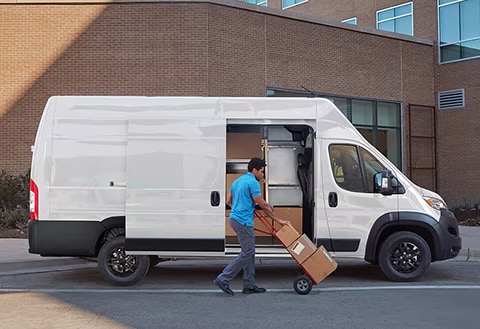
The ProMaster's flat interior walls and load floor sitting just 21 inches off the ground make loading heavy or bulky items noticeably easier, especially for workers stepping in and out repeatedly throughout the day. Max cargo volume reaches 524 cubic feet, ahead of the Transit's 487.3 cubic feet in its largest High Roof, Extended Length configuration. That gap adds up over a full day of deliveries.
Payload Ratings by Van Class
Payload comparisons depend heavily on configuration. Several Transit series max out below the ProMaster Cutaway's 5,350-lb ceiling, so businesses prioritizing payload without stepping into Ford's heaviest dual-rear-wheel trims often find the ProMaster's maximum payload rating of 5,350 lbs more accessible.
Roof Heights, Wheelbase Options, and Door Access
The Transit offers Low, Medium, and High roof heights ranging from 82.4 inches up to 110.4 inches, with High Roof standing room reaching 6 feet 5 inches. The ProMaster counters with Low, Standard, and High roof options and interior standing room up to 72.3 inches, plus 118-inch, 136-inch, and 159-inch wheelbases. On the door side, the ProMaster's sliding passenger door opens to a 49-inch width and rear doors swing open 260 degrees, both meaningful for mobile service techs loading equipment through narrow parking spots.
Maneuverability and Everyday Drivability for Fleet Use
Day-to-day drivability often decides which van a technician actually enjoys driving. The ProMaster's front-wheel drive layout and tight 36-foot turning diameter make it noticeably easier to thread through congested Plano intersections, tight loading docks, and residential cul-de-sacs across Carrollton. The Transit's rear-wheel drive setup tends to feel more stable and controlled under heavier loads, which matters for fleets running longer highway stretches across DFW with fully loaded cargo bays.
Neither van dominates outright here; the choice depends on whether your typical day involves more parking lot maneuvers or more sustained highway miles.
Upfit Potential and Real-World Applications by Trade
Commercial vans rarely stay stock for long. Whether a van fits the job usually comes down to racking, shelving, and how well it takes to trade-specific builds.
Racking, Shelving, and Conversion Compatibility
The ProMaster's flat walls and available Upfitter Interface Module (part of the Upfitter's Prep Package) simplify electrical integration for racking, shelving, and custom conversions, and its low, level floor makes shelving installation more straightforward for upfitters. Ford's Transit is often favored for its broad aftermarket compatibility, supported by trade-specific packages built for electricians, HVAC crews, and general contractors alike, along with wall liner kits, grab handles, and the Vehicle Integration System 2.0 for Chassis Cab and Cutaway builds.
Best Fit for Delivery, Trades, Mobile Service, and Passenger Use
Picture an HVAC technician who needs a low step-in height and wide door access for hauling ductwork through tight residential driveways. The ProMaster's low floor and 260-degree rear doors handle that scenario well. A delivery fleet running dense routes through Plano benefits from the ProMaster's larger cargo cube and tighter turning radius.
Mobile service vans needing wide door access for frequent in-and-out stops also lean toward the ProMaster's configuration. The Transit, by contrast, tends to shine for passenger transport and mixed-use fleets, thanks to seating flexibility and its available AWD for businesses covering rural or highway-heavy territory outside the metroplex.
Technology, Safety Features, and Fleet Management Tools
Ford's Transit currently offers a more expansive technology suite, including a standard 12-inch Sync 4 touchscreen with 5G connectivity, wireless smartphone integration, a standard 5G modem, with an available Ford Connectivity Package (included for one year) providing Wi-Fi for up to 10 connected devices, and Ford Co-Pilot360 with Pre-Collision Assist, automatic emergency braking, lane-keeping, and parking sensors as standard equipment. Ford Pro Telematics rounds out fleet management capabilities.
The ProMaster holds its own on safety too, with standard forward collision warning, automatic emergency braking, lane departure warning, and a backup camera, plus available Level 2 autonomous driving. Its Uconnect 5 system comes standard with over-the-air updates and a 7-inch touchscreen, with a 10.1-inch display available, and RAM Telematics supports fleet tracking. The Crew Van Package also seats up to six, useful for crews traveling with equipment.
If financing a configuration that fits your tech and safety priorities is the next step, you can get pre-approved for financing before visiting the lot.
Maintenance, Reliability, and Total Cost of Ownership
Both vans start from a strong reliability baseline. Autopom estimates engine life for the ProMaster and the Transit alike at somewhere between 200,000 and 300,000 miles, and Ford reports that 98% of the 1.5 million Transit vans built in the U.S. since 2014 remain in service today.
Where the ProMaster pulls ahead is in what Ram is willing to put in writing. Every 2026 ProMaster carries a 10-year/100,000-mile limited powertrain warranty for the original retail owner, double the term Ford covers the Transit for and a direct signal of Ram's confidence in the 3.6L Pentastar.
The ProMaster also asks less of your service calendar, with an oil change ceiling of 10,000 miles or 12 months, so a van running steady highway routes makes noticeably fewer scheduled stops per year. Five-year maintenance estimates still favor the Transit at over $5,600 against over $9,000 for the ProMaster, though the ProMaster spreads that spend across fewer visits and less downtime per van.
Which Van Works Harder for Plano-Area Businesses?
There's no universal winner in the RAM ProMaster vs Ford Transit comparison. The right pick depends on what you haul, where you drive it, and how much you value warranty coverage over configuration breadth.
Choose the RAM ProMaster If…
Your routes run through dense urban areas in Plano, Garland, or Carrollton, where tight turns and frequent stops are the norm. You need maximum cargo cube and a low load floor for racking, shelving, or heavy equipment access. Long-term powertrain coverage and simplified maintenance intervals matter more to you than engine variety. Your cargo shape favors flat walls and consistent floor height over multiple roof and wheelbase permutations.
Choose the Ford Transit If…
You regularly tow trailers and want access to EcoBoost torque on specific configurations. Your operation covers mixed terrain or weather conditions where AWD adds real value. You need the widest range of body lengths, roof heights, and wheelbase combinations for a varied fleet. Passenger transport or advanced connected technology matter to you alongside cargo hauling.
Explore RAM ProMaster Inventory and Financing at Huffines CDJR Plano
When you compare the 2026 RAM ProMaster vs Ford Transit side by side, the ProMaster is the better pick for businesses that value cargo efficiency, a genuinely low load floor, and a powertrain warranty built for the long haul.
Huffines Chrysler Jeep Dodge Ram Plano backs that value with a no-pressure sales approach, transparent pricing, and no dealer add-ons, so commercial buyers don't have to brace for surprises during upfit negotiations.
Browse the ProMaster lineup or contact our team to talk through which configuration actually fits your workday.