





Choosing a new vehicle means weighing performance against protection, and for many shoppers considering the 2026 Jeep lineup, understanding how safe new Jeeps are ranks among their top priorities. At Huffines Chrysler Jeep Dodge RAM Plano, we see this question daily from families and adventurers alike. Today's Jeep models blend legendary off-road capability with sophisticated safety technology designed for real-world driving conditions, from daily commutes on Plano highways to weekend adventures beyond paved roads.
Understanding Jeep Safety: Active vs. Passive Protection
Jeep engineers approach vehicle safety through two complementary strategies. Active safety features prevent accidents before they happen, using sensors, cameras, and intelligent systems to monitor surroundings and help drivers avoid hazards. These technologies constantly scan the road ahead, watch blind spots, and can even apply brakes when danger appears.
Passive safety features protect occupants when collisions become unavoidable. High-strength steel frames absorb and redirect collision forces away from the passenger compartment, while advanced restraint systems and strategically placed airbags minimize injury severity. The 2026 Jeep lineup integrates both protection philosophies, creating vehicles that actively prevent accidents while passively protecting occupants when prevention fails.
This dual approach addresses the reality that Jeep safety features must perform across diverse scenarios, whether you're navigating congested urban intersections or tackling remote trails where help might be miles away.
Active Safety Technology in the 2026 Jeep Lineup
The 2026 models represent a significant leap forward in preventative safety technology. Forward-facing radar and camera arrays continuously monitor traffic patterns, pedestrian movement, and road conditions to provide warnings or automated interventions when sensors identify concerning situations. Enhanced visibility systems extend awareness beyond windows and mirrors, tracking vehicles approaching from behind, detecting cross-traffic when backing out, and alerting drivers to lane drift during highway driving.
Collision Prevention Systems
Full-Speed Forward Collision Warning with Active Braking stands as one of the most crucial innovations across our 2026 lineup. Radar sensors mounted in the front grille continuously measure distance and closing speed between your vehicle and traffic ahead. When the system calculates potential collision risk, it provides visual and audible warnings to prompt driver action. If you don't respond quickly enough, the system automatically applies full braking force to prevent impact or significantly reduce collision speed.
This technology shines during momentary distractions: a quick glance at your phone, attention directed toward a child in the backseat, or simple fatigue on long drives. Pedestrian and cyclist detection extends this protection to vulnerable road users, applying appropriate braking responses based on the specific hazard detected. This capability proves particularly valuable in urban environments where shopping districts, school zones, and residential areas create complex traffic patterns.
Blind-Spot and Cross-Traffic Monitoring
Blind-spot monitoring transforms one of driving's most persistent hazards into a manageable risk. Radar sensors embedded in the rear quarter panels detect vehicles traveling in adjacent lanes outside mirror coverage. When another vehicle enters your blind spot, a warning indicator illuminates in the corresponding side mirror. If you activate your turn signal while a vehicle occupies that blind zone, the system escalates to a more urgent alert.
Rear cross-traffic alert provides similar protection when backing out of parking spaces, monitoring approaching traffic from both directions. This feature proves especially valuable in crowded parking lots where parked vehicles obstruct your view until you've already backed partially into the traffic lane.
Driver-Assist Features for Everyday Confidence
Beyond emergency intervention systems, the 2026 Jeep models include driver-assist technologies that make routine driving less stressful and safer. We particularly appreciate how these features support better decision-making and reduce the fatigue that leads to mistakes, especially during long highway stretches common in North Texas.
Adaptive Cruise Control and Lane Safety
Adaptive cruise control with Stop & Go functionality represents a significant evolution beyond traditional speed-holding systems. Using forward radar to monitor traffic ahead, adaptive cruise automatically adjusts your speed to maintain safe following distance. When traffic slows, your Jeep reduces speed accordingly. When the road clears, the system accelerates back to your preset cruising speed.
Active Lane Management uses cameras to track road markings and applies gentle steering inputs to keep your vehicle centered in its lane. While drivers must keep hands on the wheel and remain attentive, the technology reduces the small corrections needed to maintain proper position during extended highway drives connecting Plano to other Dallas-Fort Worth destinations.
Parking Assistance and 360-Degree Camera Views
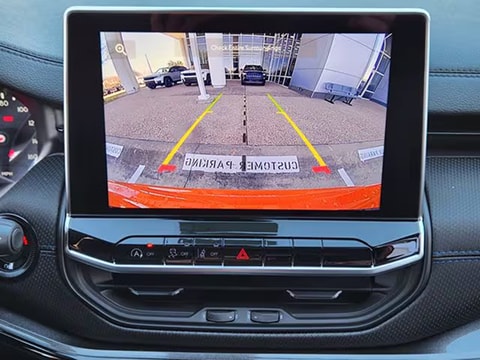
ParkSense Rear Park Assist comes standard across the Jeep lineup, but higher trims offer 360° surround view camera systems that create a virtual bird's-eye perspective of your vehicle and immediate surroundings. Four wide-angle cameras mounted on the front, rear, and sides stitch together into a single overhead view displayed on your center touchscreen.
Dynamic gridlines overlay the camera view, projecting your vehicle's path based on current steering wheel position. As you turn the wheel, these guidelines adjust in real-time, showing exactly where your vehicle will travel and making parallel parking nearly foolproof.
Structural Safety and Traction Confidence
The foundation of Jeep safety extends beyond electronic systems to the fundamental architecture of each vehicle. Jeep engineers design body structures using high-strength steel in strategic locations, creating safety cages that maintain passenger compartment integrity during collisions. Crumple zones at the front and rear absorb impact energy through controlled deformation, dissipating crash forces before they reach occupants.
Advanced electronic stability control monitors steering input, wheel speeds, and vehicle trajectory multiple times per second. When the system detects that the vehicle isn't responding as intended (such as during an emergency lane change or when cornering too quickly for conditions), it selectively applies brakes to individual wheels and reduces engine power to help restore control.
Airbags and Multi-Stage Protection
Modern Jeep models deploy comprehensive airbag systems designed to protect occupants from multiple impact angles. Front airbags provide forward collision protection, while side-curtain airbags deploy from roof rails to protect heads during side impacts or rollovers. Knee airbags prevent lower leg injuries, and seat-mounted side airbags protect the torso during lateral impacts. This multi-stage protection system adapts deployment force based on crash severity and occupant position detected by seat sensors.
Traction control works alongside stability systems, preventing wheel spin during acceleration on slippery surfaces. This proves valuable when accelerating from stops on wet roads or navigating rare winter weather conditions in the Plano area.
Available 4x4 Systems and Weather Confidence
Jeep's legendary 4x4 systems contribute directly to safety by maintaining traction and control across varied terrain and weather conditions. When roads turn slick from rain or flooding, four-wheel drive distributes engine power to all four wheels, helping prevent the loss of traction that can leave two-wheel-drive vehicles spinning helplessly. The technology proves particularly valuable during Texas thunderstorms that can suddenly flood roadways.
Different 4x4 configurations serve different purposes. Full-time systems constantly split power between front and rear axles, providing maximum grip without requiring driver intervention. Part-time systems allow drivers to engage four-wheel drive when conditions demand it. More advanced systems like Quadra-Trac automatically vary power distribution based on wheel slip, delivering torque to the wheels with the most traction.
How to Verify Safety Features on a Specific Jeep
Not all Jeep models include identical safety equipment. Features vary by trim level and optional packages. Before finalizing any purchase, we recommend verifying exactly which safety technologies come standard and which require optional packages. The window sticker on new vehicles lists all included equipment, while online build tools let you compare features across different configurations.
Government crash test ratings provide objective safety assessments. The National Highway Traffic Safety Administration conducts frontal, side, and rollover resistance tests, assigning overall safety ratings. The Insurance Institute for Highway Safety performs additional tests including small-overlap frontal crashes and roof strength evaluations. These independent evaluations help shoppers understand how well vehicles protect occupants in various collision scenarios, similar to how safety features parents prioritize guide family vehicle decisions.
Compare Trims and Experience Jeep Safety at Huffines CJDR Plano
The best way to understand how safe new Jeeps are involves experiencing the safety technologies firsthand during test drives. Here's how different models in our 2026 lineup stack up:
|
Model |
Key Active Safety Features |
Structural/Traction Highlights |
|
Wrangler |
Adaptive cruise control, blind-spot monitoring, ParkSense rear park assist, automatic high-beam headlamps |
Stability control, available 4x4, multiple airbags |
|
Compass |
Full-speed forward collision warning with active braking, pedestrian and cyclist detection, lane-keeping assist, blind-spot monitoring |
Airbags, stability control, standard all-wheel drive |
|
Cherokee |
Over 140 standard and available safety features, adaptive cruise control, lane-keeping assist, automatic emergency braking |
Turbo hybrid 4x4, up to 20 inches water-fording, 3,500 lbs towing |
|
Grand Cherokee |
Hands-Free Active Driving Assist, 360° surround view, adaptive cruise with Stop & Go, lane-keeping assist, blind-spot monitoring, automatic emergency braking |
Most standard safety and security features in its class |
|
Gladiator |
Adaptive cruise control with Stop & Go, blind-spot monitoring, Full-Speed Forward Collision Warning with Active Braking |
Over 85 standard and available safety and security features |
|
Grand Wagoneer |
Over 170 standard and available safety features, Active Driving Assist, full-speed forward collision warning with active braking, pedestrian/cyclist braking, blind-spot monitoring |
Rear-facing FamCAM interior monitoring |
Schedule Your Test Drive
At our dealership located at 4500 W Plano Parkway, you can browse our 2026 Jeep inventory and compare trim levels to find the right balance of safety features, performance capability, and value. Test-driving various trims lets you evaluate how different safety features perform in real conditions: activate the blind-spot monitoring during lane changes, test the parking assistance cameras in tight spaces, and experience how adaptive cruise control responds to traffic.